
Thursday, February 06, 2020
Moving to a new blog.


Wednesday, March 20, 2019
THE AUTHOR AND THE VLP: Another Publishing Fable

Once more upon a time a young freelance writer wrote the first five chapters of a short novel for kids. Knowing nothing of the book publishing business, the writer was now faced with the dilemma of how to get his work into print. There were three publishers in his town to choose from: the Very Small Publisher (VSP), the Medium-Sized Publisher (MSP), and the Very Large Publisher (VLP). Rationalizing that as a beginner it was probably best to start modestly, the writer sent the novel fragment to the VSP.
As the months went by the writer concerned himself with making a living as a freelancer and his attempted foray into the world of authorship faded until, almost eleven months later, a letter appeared in his mailbox requesting the rest of the manuscript for consideration. This was exciting but there was a problem—there was no ‘rest of the manuscript.’ In a panic, he phoned the publisher and asked, “When do you need to see the manuscript by?” He was told, “Before the next editorial board meeting in two months time.” He said, “Oh good. There’s still some polishing I would like to do,” and sat down and wrote the novel. As a freelancer the writer was used deadlines and frantically managed to scribble down the rest of his story in time. Two years later it was published and he realized that he had become an author.
Over the next few years, the author published several titles with the VSP and enjoyed the experience. He liked that the person he spoke to was the owner with the power to make decisions and that the VSP cared about his stories and turned them into high-quality, good-looking books. Of course there was a downside, advances and print-runs were small and there was not much in the way of a marketing budget but the VSP did the basics well and placed his books on bookstore shelves, obtained reviews and awards consideration, and even on a few occasions used the modest marketing budget to give the author financial support when he travelled to talk in schools.
As his bibliography grew the author began to wonder if the MSP, who published many more books per season than the VSP, might be able to promote his books more and increase sales and revenue. He sent them a manuscript. They liked it, agreed to publish it and even took on a backlist title that the VSP had let go. At first the author was happy to be taking the next step in his career—everything went well and everyone at the MSP seemed very nice and keen. Then the author began to notice something: the contracts with the MSP didn’t offer as much in the way of royalties as the VSP had, his titles were hard to find in bookstores and there were occasional discrepancies in the sales figures that he could discover and those recorded in the royalty statements. The author did some research, talked with other MSP authors and discovered that the MSP didn’t really care for any individual titles. Their philosophy was simply to publish as many books as possible and not spend much on marketing and promotion. They did this for two reasons: a shotgun approach increasing the chances that a best-seller would fall into their laps with no effort, and the number of books published each year determined the level of grant funding they received from the government. Okay, thought the author, I’ll try my luck with the VLP, surely they will have the marketing budget to do my books justice.
The author approached the VLP and pitched a series of novels dealing with young people caught up in a war, the anniversary of which was fast approaching. He suggested that with good marketing—a strong electronic presence (eg. blogs tying events in the books to anniversaries of the war, tweeting, etc.), learning resource packages and extensive author tours to schools—the VLP should be able to position itself during the anniversary as the go-to place for teachers and librarians looking for accessible material for their students. The VLP was enthusiastic and a three book contract was signed.
As he worked on the novels, the author had another idea. He had come across some remarkable illustrations from the war and thought they would make a striking non-fiction book unlike anything else on the market. He rationalized that the VLP could combine the marketing clout for the novel series and the non-fiction book. He drew up a second marketing plan that built on the one for the novels (expanded websites, blogs and even more intense touring), and added some non-traditional ideas for the non-fiction illustrated diary.
The author established that there were gift shops that sold books at over 100 military-focussed museums which catered to tens of thousands of visitors each year. Surely they would be interested in carrying historically accurate fiction and non-fiction books about the very subject they existed to promote? He also determined that there was a veteran’s organization with over a thousand halls and more than quarter of a million members. Would they not jump at a bookstore discount from the VLP so that members could purchase books for their grandkids?
He presented his ideas to the VLP. “Great,” the VLP said. “We love it when our authors come up with ideas for marketing their books.”
The author was pleased that the VLP liked his ideas and suppressed the tiny wriggling worm of doubt in the back of his mind that kept suggesting that the above statement was rather akin to him saying to the VLP, “Great. I love it when my publisher writes some of the chapters for me.”
The books were published as planned and the author upgraded his website, began a blog about the war and tweeted as each title came out. The VLP said, “Well done.”
The author presented his books to thousands of kids and signed countless copies in bookstores. The VLP said, “Well done.”
The author asked teachers and librarians if they had received any information or learning materials related to his books—none had.
He visited military museums searching for his books in the gift shops—in vain.
He dropped into veteran’s halls and asked if they had been offered any of his books by either their parent organization or the VLP—they hadn’t.
The author asked the VLP how the marketing plan was going. “It’s going well,” he was told. “The website, blog and tweets are good and we love the touring and book signings that you’re doing.”
“Okay,” the author said, “but I’m doing all that. The VLP isn’t promoting the website or blog or retweeting the tweets, and didn’t our marketing plan call for placing the books in museums and with veteran’s organizations?”
“Times are hard in the publishing industry,” the VLP said. “We have a limited marketing budget and many books to promote.” (At this point, the VLP mentioned a recent runaway bestseller by a famous internationally recognized author) “It’s also very difficult to pursue non-traditional marketing outlets and our sales staff are fully occupied promoting our books through traditional channels.”
The author accepted that the publishing landscape was difficult to navigate for publishers and writers, that marketing departments generally worked hard to promote books in traditional markets, and that with so many books coming out each season, it was impossible to devote equal time, energy and resources to every title. However, he was confused that one branch of the VLP thought his marketing ideas were good and another thought them too difficult to implement. He wondered at the marketing rational that threw money at a new title from a famous author that would be a bestseller regardless of marketing. He was disappointed that the VLP had done no better job marketing and promoting his books than the VSP he had started out with.
The author considered returning to the VSP that had treated him so well many years before, only to find that it had all been swallowed by the VLP. Gradually the idea of setting up his own very personal publishing company grew. Of course, it would limit him to eBooks, but he would write whatever type of book he wanted, market it any imaginative way that came to him, and only he would be responsible for its success or failure. He would call it ESCAPE—the Exceedingly Small Creatively Advertised Publishing Enterprise—but that’s a different fable.
Monday, March 04, 2019
NATURAL HISTORY LESSONS


(This was written in 1993 when I was a shiny new parent but, neither the addition of a third child nor the mushrooming of the internet as a source of information, have improved the situation. The names have been changed, as has the identity of the duck, to protect the innocent.)
Before I had children of my own, I used to think that the most difficult part of bringing them up would be attending to soiled diapers. After they could attend to their own bodily functions the rest, with the possible exception of the teenage years, would be a breeze. As far as I could remember, my parents had managed almost effortlessly. Two children and five years later, I have developed a healthy respect for my parents' abilities, and come to the realization that the diapers are the easy bit.
What is difficult is the eternal battle against the unrelenting stream of stimuli being fed to children who have not yet developed the ethical or moral framework to make their own judgements. Children today are a part of the adult world as never before. They see the same things we do and are just as subject to advertising pressures and propaganda as we are. How can we prepare them to face this onslaught which we find so difficult to resist?
I have a friend who refuses to own a television set because he believes it to be a bad influence on his children. I admire his fortitude but there are two problems with his approach. The first is that he denies himself and his family the benefit of the good on TV. My kids have learned a vast amount from Sesame Street, notwithstanding the occasional times I have been late in switching it off and found two tiny minds engrossed in the machinations of Another World. Good television opens up a world of wonder for a child and feeds the imagination.
The second problem with my friend's approach is more important. All his effort is largely futile. We all try to protect our offspring from unwanted influences, but that is only truly possible for the first few months of life. As soon as daycare, visits to friend's houses and school intervene in our children's lives we, as parents, lose control. I have never brought up the subjects of Barbie or Power Rangers, yet our house is littered with both. All I can do is show my children that there is more to the world than either.
In one sense, children are true primitives. They are not contaminated by the world around them and have no moral basis by which to judge actions and ideas. On the other hand, they have the ability to create entire mythologies from a few snippets of information gleaned from their intellectually overextended parents and this is what makes it such a long, difficult process to provide them with a rational framework.
For example, a few weeks ago, my four-year-old daughter, Megan, asked “How did the world form?” I hummed and hawed and tried to change the subject but, like a dog with a favourite bone, she worried at me until she got an answer. Finally, I dredged up all I could remember about the origins of the solar system and simplified it into something to the effect that once, long before even the dinosaurs, the sun had been surrounded by dust. Very slowly, the bits of dust stuck together until they formed the world and the other planets. I left out the stuff about the big bang and spinning vortices within the dust clouds, not because she wouldn't understand them, but because I didn't. This seemed to satisfy her and, in the ensuing silence, I found myself wondering how long it could be before the dreaded questions about sex began.
I had completely forgotten about the origins of the world when, about three weeks later, Megan asked me to come into her playroom to see a picture she had done on her chalkboard. It was a large circle surrounded by radiating lines. At the end of each radiating line was a small, carefully drawn, white dot.
“Do you know what this is?” she asked. I admitted to being at a loss. “This is the sun,” she said pointing to the circle with the air of someone used to talking to very small children. “Do you know what these are?” she was indicating the white dots.
“Stars?” I ventured tentatively.
“No. These are the little bits of dust which stuck together to form the world.”
The simple little story which I had dredged up to save face and forgotten almost immediately, had been remembered, incorporated into a child's cosmology, and regurgitated as a complete, coherent visual image. I made a mental note to do two things. Firstly, to always draw distinctions between fantasy and reality and, secondly, when reality was the topic under discussion, to try and give as accurate an explanation of the natural world as possible.
My first rule was underlined almost immediately by a problem Megan had at pre-school. She couldn't decide which of two boys in her class she was going to marry, James or Paul. The problem bothered her for a couple of weeks until it was unwittingly resolved by a third boy David. Apparently David had, in some way, been mean to Megan. Paul cavalierly came forward and offered to kill David. No one had an idea of what kill meant, nor did they have the life experience to distinguish reality from fantasy. To Megan it appeared to be the ideal solution to two problems. Paul kills David, Megan marries Paul and Dad makes a fortune selling the movie rights.
Paul probably picked up the idea from television. Even if I were to prevent Megan from watching television, its influence would still make itself felt through her peers. My role could not be to protect her from all potentially damaging influences, but to teach her broader lessons, in this case, that killing is wrong, a task much more complex that it appeared at first sight.
This kindergarten murder plot was a complex issue, but at least my second rule, to explain the natural world accurately, would be easy. I was trained as a scientist. Therefore, I take pride in my ability to view the world around me with a rational eye. The arrival of two hopelessly irrational children has shaken, but not destroyed, this pride. Children are not rational. Therefore, they obey few of the intellectual rules I find so necessary. With a cruelly perceptive eye, they look at the framework of sanity which I have constructed around my life and ask - why? Of course, they ask their fair share of impossible questions, “Why are there trees?” or “Why is that man over there like that?” but, whenever I am able, I try to present them with what I perceive to be the truth.
My approach worked well, until the day we had roast duck for supper. I was preparing to put the defrosted beast into the oven when I thought “What a good opportunity to teach Megan.” Knowing she was going through a phase of being fascinated by internal anatomy, I called her over and asked if she wanted to see what was inside a duck. Enthusiastically, she pulled her stool over and stood enthralled as I explained that the pallid lump in front of us once looked something like the creatures to which we fed bread crumbs at the park. I felt it necessary to explain the processing of the duck because I knew I was going to have to explain why the internal organs came in a little plastic bag.
I explained that ducks, while looking very different from us on the outside, were similar inside. They too had a heart, lungs, a liver and kidneys, the organs I reasoned I had most chance of finding. Megan had reached a high pitch of expectation when I finally allowed myself a theatrical flourish, pulled out the bag and emptied it onto the countertop to reveal - four hearts.
We both had a moment of silent wonder at this remarkable animal, before I realized that I had not taken account of the machinery of animal product mass processing which does not care about the identity or ownership of the contents of the little plastic bags as long as one goes in each duck. I back-pedalled frantically, but my build-up had been too good and I now have a child who believes that, at least some ducks, have four hearts.
This will not be a tremendous handicap in life as long as she can avoid biology exam questions on migratory waterfowl. However, it does illustrate the pitfalls inherent in teaching a mind with no preconceived notions. In Megan's imagination, worlds that form out of little specks of dust and ducks with four hearts are as plausible as white rabbits with watches and turtles named after renaissance painters.
I no longer have to change diapers, but I do have to deal with the morality of murder, the origins of the solar system and the entrails of a duck. The positive side to all this is that I have a clearer understanding of Megan's world. The problem is that I am not sure she is any closer to understanding mine. Fortunately, past experience seems to suggest that children do become adults before their parents regress completely. So it appears that I have some time. In any case, right now I'm busy. Megan wants me to tell her the story of Humphrey the kindly duck, and how he came to have more heart than anyone else in the farmyard.
Tuesday, February 19, 2019
THE WRITER AND THE MARKETER: A Publishing Fable

Once upon a time there was a young freelance writer who wanted to write books. He wrote a few short novels for kids, but deep down he wanted to write something big for adults. By chance one day while researching another short novel, he came upon the beginning of a journal written by a long-lost Arctic explorer. The journal was only a few thousand words long and ended abruptly when the explorer set off into the unknown and disappeared, but the writer was strangely drawn to the fragment and felt oddly akin to the man who had vanished more than a century and a half before. Unable to get the journal out of his mind, the writer decided to try and enter the explorer’s reality and recreate something of what he might have written before he died and his journal was lost.
Like many stories, the writer’s project took on a life of its own. Several times, he thought he had finished this exercise and went on to something else, but every time he tried, the dead explorer would return and say, “No, my friend. My story’s not finished. Like me, you have to go on to the end.” So the writer continued and eventually ended up with 120,000 words that he was quite proud of and, which he felt, did some measure of justice to his dead co-author. He began to wonder how he could share the explorer’s tale with a wider audience. He envisaged a book, a handwritten book with occasional pen and ink sketches bound in an aged water-stained leather cover. He made a mock-up of how he thought the first 20 pages of his vision would look, created a backstory of how the journal had been found beneath a “long forgotten, lonely cairn of stones”* and sent it off to his agent.
The agent knew that the vice-president of a major publishing house had an interest in Arctic exploration and so arrange a meeting between him and the writer. The two got on well and exchanged Arctic stories. The vice-president liked the idea of the book-as-art—that it would be of interest and value as an object over and above the story within. He agreed to read the manuscript. Two days later, the vice-president phoned the writer to say how much he had enjoyed the manuscript, how good he thought the idea was, how well it was written and that he was going to present it to the president of the publishing house. The writer was excited about this, since quick-response, enthusiastic phone calls from publishers were as rare as proofreaders had become.
A few days later, the vice-president called once more to say that the president had also loved the idea and the story as had the several people who had seen it when he had passed it around the office. The next stage was to present it to the Editorial Board at a meeting the following Wednesday. The writer waited nervously and on Thursday morning the vice-president phoned to say that the Editorial Board had also liked the project and had given suggestions on what font could be used to mimic handwriting and still be easy to read and how the sketches could be incorporated into the text. The final step was to see, the following Wednesday, what ideas the Marketing Department could come up with to maximize the sales potential of the book.
The vice-president went on to discuss possible publishing dates and mentioned an advance that was an order of magnitude greater than the writer had ever seen before. The writer took his partner out for dinner to celebrate, then he waited. The following Wednesday came and went, as did the subsequent Thursday. By Friday afternoon, the writer could stand the waiting no more and phoned the vice-president.
“I’m terribly sorry,” the vice-president said, “but the Marketing Department couldn’t see a way to place the book effectively within our list.”
“But,” the writer stammered, “you, the president, everyone in the office thought it was a good idea and well-written. The Editorial Board was on side. We’d even begun to talk money and publication dates.”
“I know,” the vice-president said, sorrowfully, “but if the Marketing Department can’t see a way to maximize the return on the project, we just can’t take it on. I’m afraid it’s a little too different. I am sorry.”
The writer hung up and took a moment to compose himself. He thought over the emotional rollercoaster of the past few weeks and wondered at the Marketing Department having the power to overrule everyone else. He pondered all the complimentary things that had been said about the manuscript by everyone from the president on down. Then it struck him, of all the words he had heard there were only two that mattered enough to override all else. They were, “too different.”
In his naivete the writer had assumed that “different” was a good thing—that if there was no equivalent book on shelves this was plus, that a book which, by its very nature, stood out from those around it would attract attention, and that a book’s intrinsic value was determined by the story idea and by how well that was told. The Marketing Department knew better. They knew that a large, impersonal bookstore would have trouble deciding what shelf to put something different on, that standing out meant having a table of similar books to place it on, and that a book’s value depended on how like it was to the previous year’s best-sellers.
Not discouraged but disillusioned, the writer eventually placed his story with a different publisher who brought it out without the handwriting-mimicking text, the sketches or the water-stained cover. It was released to good reviews and modest sales, but the Marketing Department wasn’t really behind it and it eventually slipped into eBook limbo where, a few times a month, it was discovered by scattered Arctic enthusiasts. The writer went on to a moderately successful career as an author of children’s books, and contented himself sneaking small pieces of difference into his stories where he could. He watched with sadness the continued rise of Marketing Departments and the decrease in variety on the shelves of his local bookstore.
Eventually, the writer began to collect his pension and this freed him up to work on some projects that had lingered in the back of his mind over the years. He finished a couple of them and felt that they were good ideas well expressed, but don’t expect to see them any time soon—they’re just a little bit too different.
* from Northwest Passage by Stan Rogers
Monday, December 19, 2016
The Sketches of Russell Rabjohn

Due for publication in March, 2017, you can pre-order A Soldier's Sketchbook at amazon.ca or amazon.com.
In the meantime, here are a few of Russell's sketches.


Monday, March 11, 2013
The Heretic's Secret in ONE Volume

So now you have choices, a single volume, a trilogy, or an eleven part serialization. How long is the flight you're planning?
Wednesday, March 06, 2013
The Heretic's Secret as a Trilogy
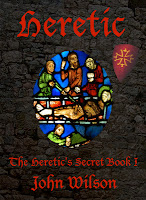


If you think serializations went out with Charles Dickens and Alexander Dumas, The Heretic's Secret is available as a trilogy, but only through Amazon.com, Amazon.co.uk, etc..
So what's it about?
In the style of Bernard Cornwell, The Heretic’s Secret Trilogy is a rollicking historical adventure set during the bloody 13th century wars against the Cathar Heretics of Languedoc. When the armoured knights of Pope Innocent III swept south in 1209, most thought they would be gone by summer’s end but, led by the fanatical Arnaud Aumery and the ambitious Simon de Montfort, they stayed for three fiery decades. In that time they slaughtered thousands of Cathars, burned countless towns and castles, destroyed a thriving country that rivaled France in power and culture, and created the foundations for the shape of western Europe we recognize.
Caught up in the horror are two childhood friends. Peter—an assistant to the shadowy, enigmatic priest who leads the crusade—is convinced that the war against the Cathars is God's will, a mission that will lead him to the highest ranks of power in Rome itself. John—who finds himself drawn to the strange ideas of the heretics—simply seeks the peace to learn and understand through reading the forbidden books hidden in remote castles across the land. As the armoured knights of the crusade destroy city after city and the flames of the Inquisition spread, Peter and John find themselves on opposite sides of a search for an ancient secret that may have the power to change the world.
"…a brave book, an unsettling book, and one that is very much needed at this time."—The Globe and Mail.
"…an astonishingly nuanced and masterfully told story…"—Quill & Quire
Subscribe to:
Posts (Atom)